Horizon
Rebuilding how a company decides what to build
Horizon predicts whether a product will sell before it exists. The engine worked. The workflow that got clients there did not. I joined as its first designer, restructured the core journey around the consumer instead of the database, and left leading the design team.
Industry - B2B SaaS – Market Validation
Role - Founding & Lead Product Designer
Timeline - 1.5 years (approx)
Platform - Web
Read - 10 min
A platform built by engineers, for engineers
Horizon could tell you whether a product would sell before you built it. Setting up the test was the part nobody could do.
Horizon runs painted door tests. You show real consumers a product that does not exist yet, on real ads and real landing pages, and you measure what they do rather than what they say they would do.
BSH used it to price a microfibre filter device that had never existed, running four price points past 6,989 consumers in seven days on a 4,000 euro ad budget, and found 199 euros was the point where demand and revenue peaked. Virgin Pure used it to raise a subscription price by more than 15% without losing demand. Bosch used it to find that a new colourway converted three times better than the original.
The engine was strong. It had been built by developers and product managers with no designer involved, and it showed. Every screen made sense to the person who built it and to almost nobody else.
I was the first designer Horizon ever hired. Over 1.5 year, I rebuilt the flight creation experience, initiated the research that settled whether we built or bought our landing page editor, found and fixed the flaw in the metric every client decision rested on, and went from solo designer to leading the design team.
What I did
Reframed a build task as a consumer journey, then built the practice that kept it honest.
Ran the discovery that reframed flight creation from assembling artefacts into designing a consumer journey
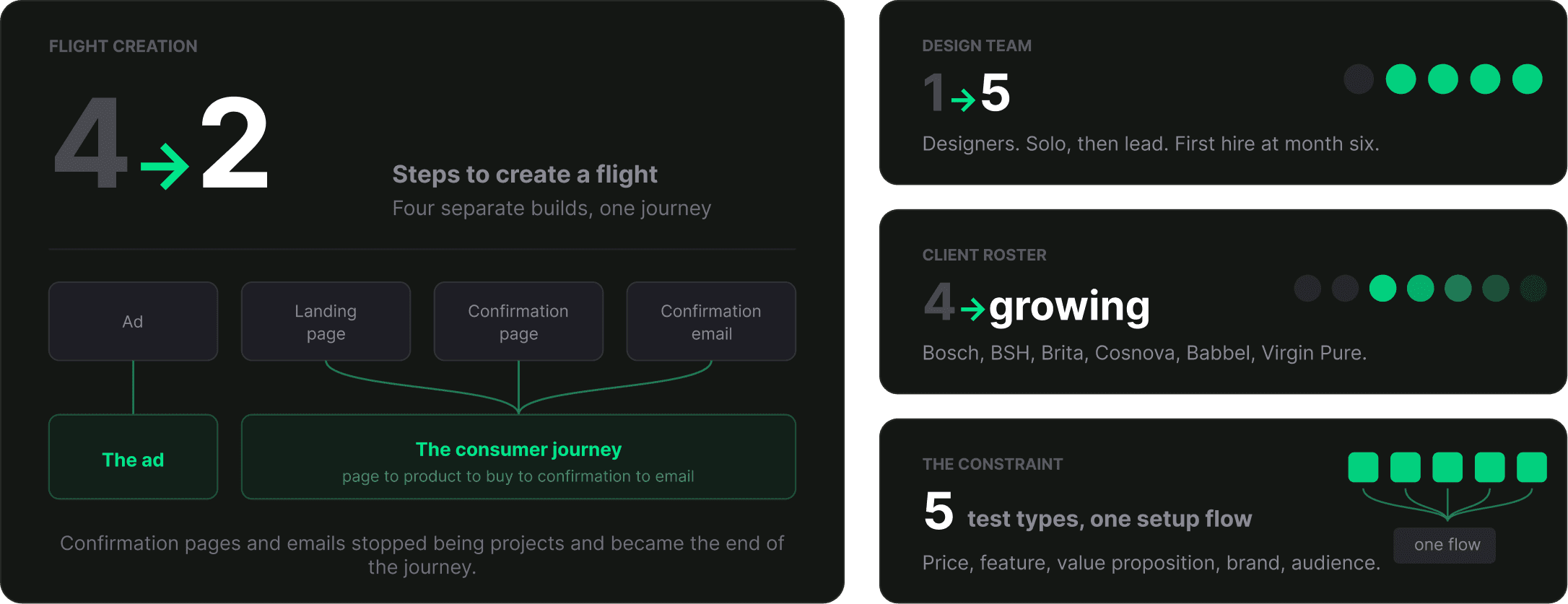
Restructured flight creation from four disconnected build steps into two
Initiated the five-tool market teardown that settled our build-versus-buy call on the landing page editor
Identified and fixed the flaw in Customer Demand Score, the single number clients were deciding on
Shipped Incognito Flights, which Horizon still sells today as Incognito Testing
Facilitated the product vision and prioritisation sessions that set company direction
Helped hire and then led the design team as it grew to five
Impact
Shipped in sprints across a year, not in a single release.
Horizon was a pre-seed company with a small user base. Rather than dress up small-sample numbers, everything on this page is something I can show you the artefact for.
What a flight is, and why building one was hard
One setup flow had to serve five completely different research questions.
A flight is Horizon's unit of work. Four stages: write the research question, design the test, field it for seven days, read the insights.
Horizon sold five kinds of flight. Price tests. Feature tests. Value proposition tests. Brand tests. Target group tests. Clients ran them across home appliances, food and beverage, cosmetics, insurance and digital services.

A four-price pricing test and a two-logo brand test have almost nothing in common except that both need ads, pages and a funnel. One flow had to carry all of it. It had been built to cover every case, and it served none of them well.
I stopped asking clients what was wrong and watched them fail instead
The most useful research I did was sitting silently in the calls where our own consultants set flights up for clients.
Horizon sold two things: a self-serve platform, and Testing-as-a-Service, where our research consultants set the flight up for you.
Those service calls were the richest data in the company and nobody was mining them. For a year I sat in one to two a month as a silent observer. I was not there to help. I was there to watch every moment a trained consultant had to explain something the interface should have said on its own.

Around that:
Interviews with four clients across my first three months, on what a flight was meant to answer and what they were actually deciding with the results
Usability testing with three clients on prototypes from month five, repeated after each iteration until the structure held
Support ticket analysis, heatmaps and behavioural analytics
The product maturity survey and customer flight surveys
The research framework the team ran sessions from.
The pattern showed up in the service calls first, and it was not what I expected.
The flow described how Horizon assembled a test, not what a consumer would experience
Four steps, four separate builds, and no point at which a client could see the journey they were paying for.
Creating a flight meant four separate builds.
Step 1, the ad. Step 2, the landing page. Step 3, the confirmation page. Step 4, the confirmation email.

Domain and DNS, configured separately for every variant, with no live validation.
Each was configured on its own screen with its own settings. Domain and DNS had to be set up separately for every single variant, with no real-time validation to tell you whether it had worked. Nothing anywhere showed how a consumer would move from seeing an ad to signalling that they wanted to buy.
That is a database schema turned into a wizard. It is not how anyone thinks about an experiment they are about to spend four thousand euros running.
“Clients were not building a test. They were assembling four things and hoping they connected.”
Clients were not confused by any individual step. Every step worked. They could not picture what their consumer would see, and so they could not tell whether the test they had built would answer their question.
Four artefacts became one journey
Build the ad. Build the journey. Everything else became configuration.
I collapsed the four build steps into two, organised around what the consumer experiences rather than what the platform stores.

Step 1, the ad. What the consumer sees on Facebook or Instagram.
Step 2, the journey. Landing page, product page, the buy action, the confirmation page, and the email capture that validates intent. Built and previewed as one continuous flow.

Confirmation pages and confirmation emails stopped being separate projects. They became the end of the journey, which is what they always were. Domain, DNS and URL configuration moved out of the build sequence into settings, applied across all variants at once, with real-time validation replacing the guesswork.

One preview, from the ad a consumer sees to the email that validates their intent.
The point was not fewer clicks. The point was that a client could now look at one screen and understand the experiment they were about to run.
I argued we should build our own editor, and brought the evidence
I taught myself five landing page tools, timed how long each one took, and put the results in front of the founders.
The landing page editor was the most complained-about part of the product. Templates were dated, customisation was limited, and clients were leaving Horizon to build pages in Unbounce and bringing them back.
The obvious answer was to licence a white-label editor. I wanted to know whether the obvious answer was the right one, so I ran a full teardown of Webflow, Framer, Unbounce, Leadpages and Canva. Not a feature matrix scraped from their marketing pages. I built a landing page in each one and timed myself.


Each tool compared on user base, target group, features, onboarding, templates, integrations, AI and pricing.
Framer took about thirty minutes to learn and produce a full page. Webflow took five hours to change three sections of an existing template, and only got there with dev knowledge I did not have.
That comparison reframed the question. Our users were product managers and consumer insights leads, not designers. Any tool that quietly assumed CSS literacy would move the bottleneck rather than remove it. And bolting a white-label product into our funnel would compromise the seamless consumer journey the entire method depends on, because the moment a consumer senses a stitched-together experience, the behavioural data stops being trustworthy.

The decision record, October 2023.
I presented the teardown to the founders. In October 2023 the decision was recorded: build in-house, for autonomy over the stack, integration quality and data control.
Our LP Editor - Enhanced
The one number clients decided on could not tell variants apart
Three price points. Three identical scores. I found it by listening, not by looking at the data.
Customer Demand Score is Horizon's headline output. One number between zero and ten telling a client whether real demand exists. Clients make six-figure decisions on it.
In one of the service sessions, a client pointed out that their variants were all returning the same score, while our consultants' manual read of the underlying data showed clear differences between them. The dashboard was flattening the exact distinction the test existed to find.


The cause was in the weighting. Call-to-action conversions were over-represented in the calculation, so any variant that earned clicks scored well regardless of what happened after the click. Purchase intent, the thing the whole method exists to measure, was being drowned out by a shallower signal upstream of it.
I raised it, we rebuilt how the score was calculated, and I redesigned the results view so the CDS segments sat underneath the headline number. Clients could now see not only what their score was, but which part of the funnel produced it.
Two additions came out of the same work. A flight summary at the top of the results view showing spend to date and data collected so far, so clients could tell when they had enough signal to stop a flight rather than burning budget. And a customer walkthrough running from ad click to double opt-in, explaining what each number in the funnel actually meant.
A flow that let clients test without showing their hand
Shipped with my team during my tenure. Horizon still sells it.
Enterprise clients had a problem the platform did not solve. Running a painted door test under your own brand tells your competitors what you are working on, and it triggers a legal review that can take longer than the test itself.
We designed a flow where Horizon supplied the imprint and legal infrastructure behind the ads and landing pages, so the client's brand and legal entity never appeared to the market. My team and I shipped it.


Still sold as a service on gethorizon.net.
It is now a named commercial service on Horizon's website.
What was still broken after we shipped
Prototype testing told us the new structure held. It also told us five things were not fixed.
The templates were better and still lacked real-world context. Clients were looking at placeholder copy and could not picture their own product in it.
Steps were down from four to two, but flight settings were not prominent enough inside the new structure.
The builder made the consumer journey legible and was still missing basics, like adding components and sections.
Connecting an externally built landing page was still hard to follow.
The results dashboard needed a walkthrough per stage before the metrics made sense to a first-time client.
We shipped as beta and kept going. The structure was right. The detail took another year of sprints, which is the honest shape of most platform work and the reason I now treat a launch as the start of the measurement rather than the end of the project.
From the only designer to leading five
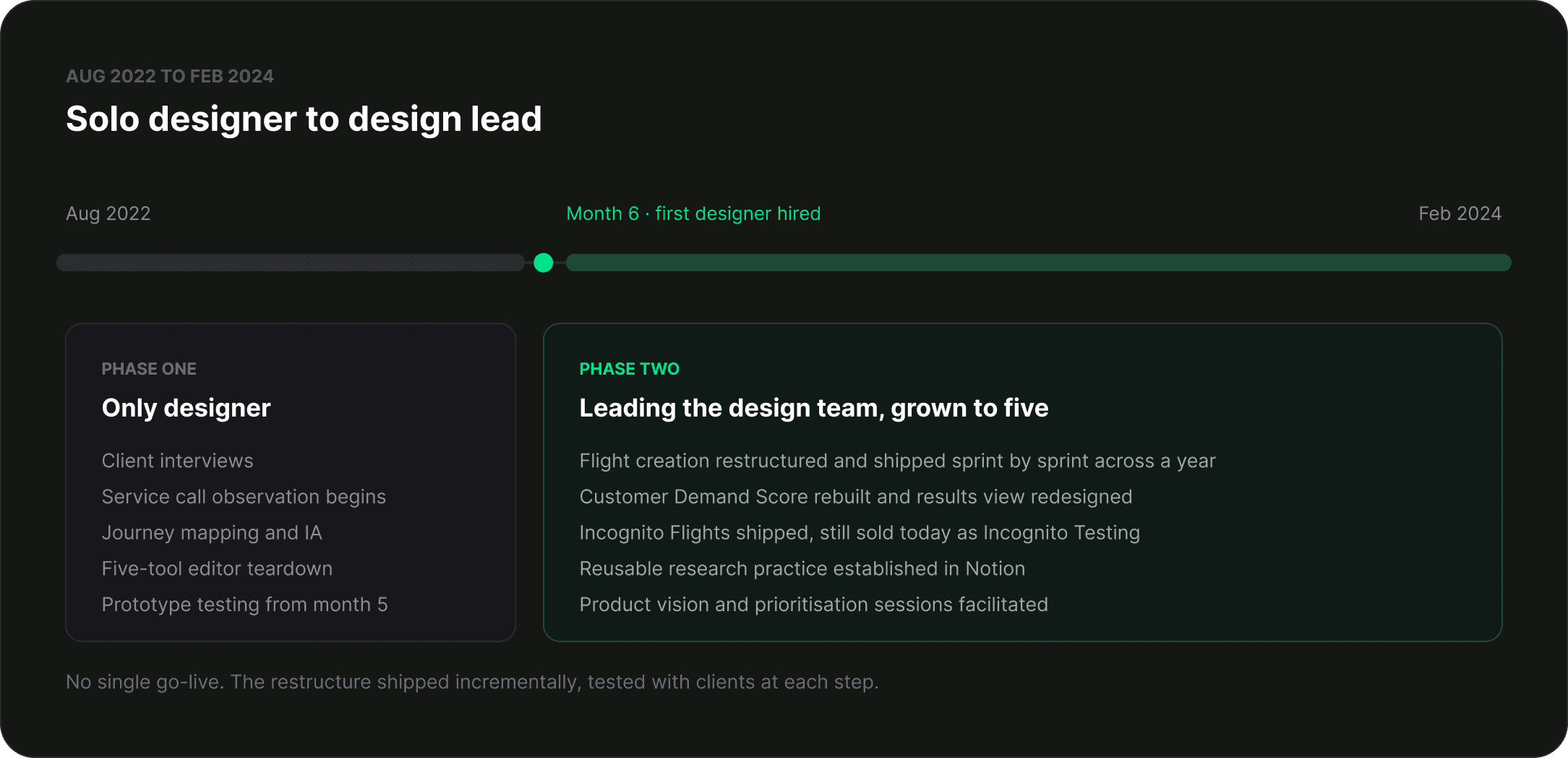
The first hire came at month six. What changed was not headcount, it was where decisions came from.
For the first six months I was the only designer at Horizon. I helped hire the first, and then led and managed the team as it grew to five.
Two things I put in place mattered more than anything I drew.
A research practice that did not depend on me. I built a reusable moderated remote usability testing framework covering the pre-session checklist, test plan, script, pre-questions, task objectives, follow-up questions, wrap-up and analysis. It lived where the team worked, other designers ran sessions from it, and research stopped being something that happened only when I was in the room.
Designers in the service calls. I made observing client and service team sessions part of how the team worked rather than a habit of mine. The Customer Demand Score problem surfaced in one of those calls. There was no good reason that insight should only ever have been available to me.

Delivery through the restructure. Sprint 4 completed 13 of 55 committed points. Sprint 7 completed 81 of 79.
I facilitated the sessions that set the company's direction
The vision we landed on is still Horizon's public positioning today.
As the team and the client base grew, the hard question stopped being how flight creation worked and became what Horizon was for.
I facilitated the product vision sessions with the founders and the wider team: target group, needs, product, unique selling point, business goals, product benefits. We mapped Horizon's own process onto a data to information to knowledge model, to separate clearly what the platform generated from what came in from outside it.
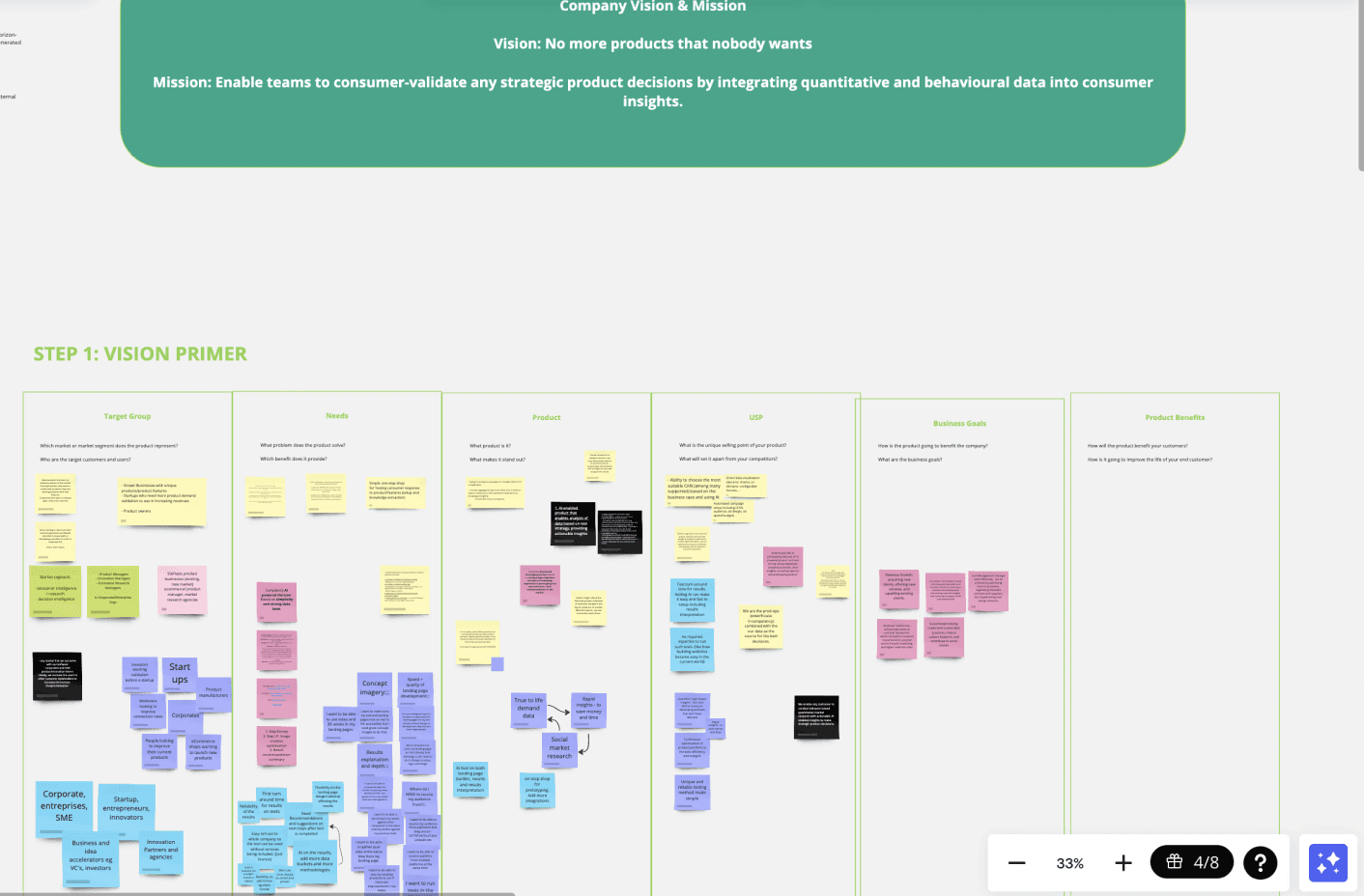

The vision session output / Horizon's About page, today
The vision that came out of those sessions was No more products that nobody wants. Horizon's About page still carries it as the company's headline today.
I then ran the prioritisation work that turned it into a roadmap, sorting every idea across feasibility and originality into what we could do now, what would genuinely differentiate us, and what was not yet possible.

That framework is what stopped a small team building whatever the loudest client had asked for last.
Reflection
Three things I took from being the first designer somewhere.
Shipping fast broke our own data. We built features quickly whenever clients asked, then found we could not connect the new data back to what came before. Clients started asking questions about their own results that we could not answer. Speed without a data model is a debt you repay in trust.
A user request is not a mandate. Some of the most-requested features were the most expensive to build and the least valuable to the business. Learning to say clearly which ones we were not doing, and why, was the part of the job that made me useful rather than just busy.
Discarding work is part of the work. We stopped mid-way on feature requests. We threw away entire sprints. Early on that felt like failure. It was the correct response to new information, and learning to do it without flinching is the difference between being a designer at a startup and being useful at one.
The redesign was never the outcome. The outcome was a company that could finally see its own consumer journey, a team that could run research without me, and a direction that outlasted my tenure.